
What Year Is My John Deere Tractor? A Practical Serial Number Guide

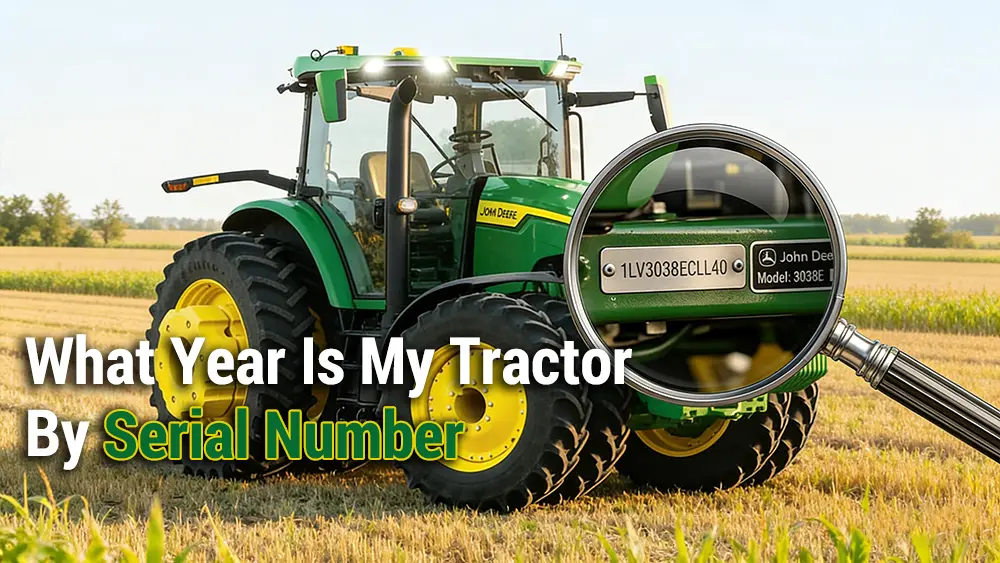
Determining the production year of a John Deere tractor is a common need for owners. Whether maintaining equipment, ordering replacement parts, assessing resale value, or ensuring regulatory compliance, the serial number (often called the Product Identification Number or PIN) provides essential information. This guide explains how to locate the number, understand its format, decode it, and use reliable resources to identify the year accurately.
Accurate year identification helps avoid ordering incompatible parts, since John Deere has updated designs, emissions systems, and components over time. It also supports proper service scheduling and informed decisions when buying or selling used machines.
Why Knowing the Tractor’s Year Matters
The manufacture year affects several practical aspects of ownership:
- Parts Compatibility: Engineering changes between years can make some components non-interchangeable. For instance, updates to hydraulic systems, electrical wiring, or engine controls may require year-specific parts.
- Maintenance and Service: Official repair manuals and fluid specifications often vary by production period. Dealers use the PIN to access the correct technical data.
- Valuation: Documented history influences market price. Well-maintained classic models from certain eras may hold collector value, while modern tractors are evaluated partly on age and usage hours.
- Emissions Standards: Newer tractors must meet specific Tier 4 or equivalent requirements. John deere serial number search helps confirm the emission tier and any applicable updates or recalls.
- Registration and Insurance: Some jurisdictions or insurers request the exact manufacture year for documentation.
Relying on approximate model years alone can lead to errors, as production for a new model often begins in the previous calendar year.
Step 1: Finding the Serial Number Plate
The location of the identification plate varies by tractor type and era. Cleaning the area gently and using good lighting can help reveal worn markings. Photograph the full plate, including the model number, for reference.

Common Locations by Tractor Category
| Tractor Category | Typical Location | Additional Tips |
| Large agricultural tractors (5 Series and higher, including 6R, 7R, 8R, 9R) | Right side of the main frame, below the engine or near the front axle | May be behind a small panel or steps on cab models |
| Compact and utility tractors (1 Series to 4 Series) | Right frame rail, above or near the front axle | Stand at the front-right corner for easiest view |
| Older row-crop and utility models (pre-2000, e.g., 4020, 4440, 6400) | Right side of transmission or clutch housing | Check for stamped numbers if the tag is missing |
| Lawn and garden tractors / riding mowers | Under the seat, rear frame between rear wheels, or on the mower deck | Also inspect the engine for a separate serial |
| Zero-turn mowers | Under the seat or in the engine compartment | Engine plate provides separate information |
These positions are based on patterns observed across John Deere equipment. Always distinguish the tractor chassis PIN from the engine serial number, which is usually stamped on the engine block and starts with different letter codes.
If the plate is missing or unreadable, consult purchase records, the operator’s manual, or the previous owner. Authorized dealers can often provide guidance with limited details.
For aftermarket parts that fit your specific year and model, reliable suppliers like AMOParts offer a wide selection of compatible components
Step 2: Understanding Serial Number Formats Over Time
John Deere has used different numbering systems depending on the production era:
- Early models (1930s–1960s): Short 5- or 6-digit sequential numbers. The year is determined by consulting model-specific ranges rather than a built-in code.
- Mid-era models (1970s–1990s): Often 6- to 13-digit numbers. These also rely on year-by-year production charts for each model.
- Modern models (late 1990s onward): Many use a standardized 17-digit PIN. Some compact and lawn equipment retain shorter formats. The 17-digit structure includes a dedicated year code.
Note that the calendar year of manufacture may differ slightly from the marketed model year, as factories often begin building next-year models in the fall.
Step 3: Decoding Modern 17-Digit PINs
For tractors built roughly from 2008 onward—especially larger agricultural models—the 17-digit PIN follows a consistent format that makes year identification straightforward.
The structure breaks down as follows (positions counted from the left):
- Positions 1–2 or 1–3: World Manufacturer Identifier (factory and country code).
- Positions for model and configuration details.
- Position 9: Check digit for validation.
- Position 10: Year of manufacture code (the most useful for quick identification).
- Position 11: Transmission or other configuration.
- Positions 12–17: Sequential production number.
Year of Manufacture Codes (10th Character)
John Deere uses a repeating alphanumeric system, skipping letters that could be confused with numbers (I, O, Q, U, Z). Here is the standard reference table:
| Year | Code (10th Digit) | Year | Code (10th Digit) | Year | Code (10th Digit) |
| 2008 | 8 | 2018 | J | 2028 | W |
| 2009 | 9 | 2019 | K | 2029 | X |
| 2010 | A | 2020 | L | 2030 | Y |
| 2011 | B | 2021 | M | 2031 | 1 |
| 2012 | C | 2022 | N | 2032 | 2 |
| 2013 | D | 2023 | P | 2033 | 3 |
| 2014 | E | 2024 | R | 2034 | 4 |
| 2015 | F | 2025 | S | 2035 | 5 |
| 2016 | G | 2026 | T | 2036 | 6 |
| 2017 | H | 2027 | V | 2037 | 7 |
Example: A PIN with “C” in the 10th position indicates manufacture in 2012. This code reflects the actual build year.
For confirmation on any specific tractor, combine this with the model number when consulting resources.
Step 4: Handling Older and Shorter Serial Numbers
For tractors with 5-, 6-, or 13-digit numbers, there is no universal single-digit year code. Instead, use model-specific serial number ranges. These lists show the starting or ending serial for each production year.
Example Serial Ranges for Selected Classic Models
| Model | Year | Approximate Serial Range Start | Notes |
| Model A | 1934 | 410000 | Early two-cylinder letter series |
| Model A | 1952 | Approaching 703384 (final) | End of production |
| 4020 | 1964 | 65000 | Early production |
| 4020 | 1972 | Around 260791 (final range) | Syncro-Range or PowerShift variants |
| 4430 | 1973 | Starting near 1000 | Part of the Generation II series |
Ranges like these are model-dependent and can vary slightly by chassis type (row-crop, standard, high-crop) or transmission. Always verify against detailed charts for the exact variant. For engine-related identification, resources such as the AMOParts blog provide helpful guidance on John Deere engine serial number lookup
Step 5: Practical Lookup Methods
Follow these steps for reliable results:
- Record the full PIN or serial number and the model designation.
- For 17-digit PINs, check the 10th character against the year table.
- For older models, visit a model-specific page on a comprehensive database and locate the serial range chart.
- Use official John Deere parts lookup tools by entering the model and PIN to view filtered catalogs and technical bulletins.
- Contact an authorized dealer for detailed build records, option lists, or confirmation. Provide both model and serial for fastest service.
Helpful free resources include TractorData.com, which lists serial ranges directly on individual model pages. Dealer networks and printed service manuals offer additional depth. A highly regarded free resource is TractorData.com, which hosts extensive model-by-model serial information
Common Challenges and Solutions
- Worn or damaged plates: Use angled lighting or gentle rubbing techniques to read faint numbers. Dealers can sometimes provide replacement tags with proper proof of ownership.
- Engine versus tractor serial: The engine number supports engine-specific repairs but does not indicate the tractor’s overall year.
- Imported models: Factory codes at the beginning of the PIN show the build location (e.g., United States, Brazil, India), which may influence parts sourcing or emissions compliance.
- Lawn and garden equipment: These often follow their own identification guidelines. Check under the seat or on the frame, and refer to dedicated mower resources.
- Discrepancies: Production timing means a “2025 model” may have been built in late 2024. The PIN reflects the actual manufacture date.
When buying used parts, request the donor machine’s full identification numbers to ensure fitment.
Additional Tips for Owners
Keep a digital and physical record of your tractor’s model and serial information. When performing maintenance, note any year-specific changes mentioned in service literature. For collector or vintage tractors, organizations focused on two-cylinder models can provide specialized research.
If your tractor is very old (pre-1960s), serial data may appear in collector publications or through enthusiast clubs.
Reliable Resources
- Official John Deere parts and service portal
- TractorData.com serial number database
- AMOParts for aftermarket and replacement options
- AMOParts blog on John Deere engine serial lookup
- Anglo Agriparts serial number guide (supplementary reference) .
Conclusion
Identifying the year of a John Deere tractor through its serial number is a valuable skill that supports better maintenance, correct parts selection, and informed ownership. By locating the identification plate, understanding the numbering format, and consulting appropriate references, most owners can determine the production year with confidence.
Whether working with a modern 17-digit PIN or an older short serial number, the process combines observation with reliable data. When in doubt, a local dealer remains the most authoritative resource for your specific machine.
Proper documentation and care help ensure your equipment performs reliably for years. If you have additional questions after checking your numbers, reach out to a certified technician with the full details in hand.
This approach prioritizes accuracy and usefulness, helping owners across different tractor types and eras keep their machines in good working order.


