The 20 Must-Know Parts of an Excavator and Their Functions!

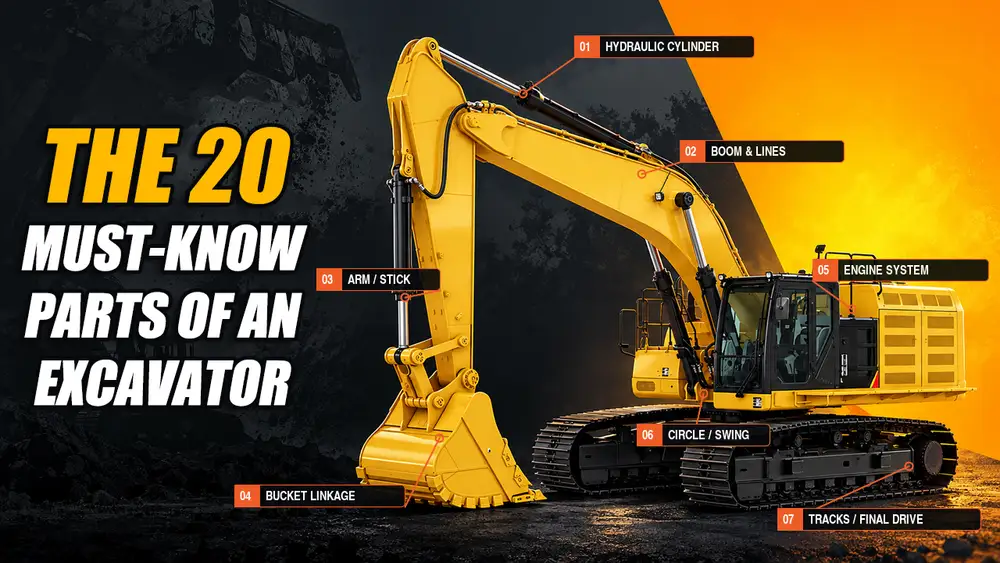
Understanding the parts of an excavator is the first step to operating, maintaining, and repairing any machine. While models vary, these 20 fundamental components form the backbone of every excavator — from compact minis to heavy-duty units.
Three Core Sections Key Parts of Excavator
- Undercarriage: Mobility foundation
- Cab: Command center
- Arm/Boom: Earth-shaping tools
Undercarriage: The Mobility System
Many critical excavator parts are housed within the undercarriage, the mobility foundation of the machine.
1.Excavator Tracks
Steel-reinforced rubber belts that transfer engine power into movement. Designed to distribute weight evenly, preventing sinking on soft terrain while providing exceptional grip.
2.Track Frame
The structural backbone supporting all undercarriage components. Its heavy-duty construction absorbs ground impacts and maintains alignment during heavy digging operations.
3.Track Pads
Replaceable rubber or polyurethane surfaces that reduce ground damage and vibration. They significantly lower noise levels while improving stability on slopes.
4.Track Pads
Interlinked forged-steel segments forming the track’s flexible spine. These heat-treated components withstand immense tension while enabling smooth articulation over obstacles.
5.Track Chains
Ground-engaging plates bolted to chains. Their angled design bites into terrain for maximum traction while self-cleaning grooves prevent mud buildup.
6.Drive Sprockets
Toothed wheels that mesh with track chains, converting hydraulic power into forward motion. Precision-hardened teeth ensure reliable engagement under extreme loads.
7.Carrier Rollers
Upper guide wheels maintaining track alignment. Sealed bearings protect against contaminants, extending service life in abrasive environments.
8.Track Rollers
Load-bearing wheels distributing machine weight across tracks. Double-flange designs prevent derailment during side-slope operations.
9.Idler Wheels
Front-mounted tensioners with adjustable positions. Their spring-loaded design maintains optimal track tension, reducing wear on chains and sprockets.
10.Swing Bearing
The excavator’s rotating heart enabling 360° movement. Precision ball races support the cab’s weight while allowing buttery-smooth rotation under full load.

Cab: The Operator’s Command Hub
The operator’s cab houses several vital excavator parts that control every machine movement.
11.Control Console
Ergonomic joysticks and touchscreens translating operator input into hydraulic commands. Modern versions feature adjustable response curves for personalized operation.
12.ROPS/FOPS Structure
Reinforced safety cage meeting ISO 3471 standards. This critical framework protects operators during rollovers or falling object impacts
13.Counterweight
Rear-mounted mass balancing the digging forces. Proper counterweighting prevents tipping while maximizing lifting capacity at full reach.
14.Diesel Engine
Turbocharged power source generating hydraulic and electrical energy. Tier 4-compliant models reduce emissions without sacrificing performance.
15.Hydraulic Power Unit
Integrated system of pumps, valves, and reservoirs delivering pressurized fluid. Advanced load-sensing systems minimize energy waste during operation.
16.Fuel System
High-capacity tank with integrated filtration. Modern designs include water-separating filters and real-time consumption monitoring.

Arm/Boom: The Earthmoving Toolkit
Precision-engineered force
17.Boom
Primary lifting arm connecting cab to digging components. Optimized geometries provide maximum reach while minimizing weight stress.
18.Dipper Arm
Articulated extension that positions the bucket. Its variable-length designs allow customized digging depth and dumping height.
19.Workhorse Bucket
Ground-engaging tool with replaceable teeth. Multiple configurations exist for specialized tasks (rock, trenching, grading).
20.Hydraulic Quick Coupler
Revolutionary attachment system enabling tool changes in seconds. Eliminates manual pin removal, dramatically increasing jobsite efficiency.
Key Attachments
- Hydraulic Breakers: Concrete demolition
- Augers: Precision hole drilling
- Tiltrotators: 360° bucket positioning
- Grading Buckets: Finish-level accuracy
- Tree Shears: Forestry management

Troubleshooting Common Excavator Component Issues
⚠️ Caution: Hydraulic systems store pressure even when the engine is off. Never loosen fittings or open lines before relieving pressure — let a qualified technician handle pressurized components.
| Symptom | Possible Cause(s) | Potential Solution |
|---|---|---|
| Slow or weak hydraulics | Low hydraulic fluid; clogged hydraulic filter; worn hydraulic pump | Check fluid level; replace filter; inspect the hydraulic pump for wear or damage |
| Machine drifts or won’t stay still | Worn seals in a hydraulic cylinder; faulty control valve | Inspect cylinders for leaks; have the control valve tested by a technician |
| Excessive track noise | Worn rollers or idlers; improper track tension (too loose or too tight) | Inspect undercarriage components for wear; adjust track tension |
| House won’t swing smoothly | Low swing motor pressure; damaged swing bearing (also called slewing bearing) | Check hydraulic pressure to the swing motor; inspect the swing bearing for damage or lack of grease |
For more reference on heavy‑equipment component standards, you can visit the official construction equipment resource
Frequently Asked Questions
Here are some of the most common queries about the parts of an excavator.
How many parts does an excavator have?
While excavators contain thousands of individual components, these 20 core excavator parts form the essential operational framework across nearly all machine models.
What is the end of an excavator called?
The end of an excavator is called the bucket, which digs into the earth and scoops material. Buckets come in rock, trenching, and grading configurations.
What is the arm of an excavator called?
The arm is commonly called the arm, dipper, or stick — the articulated section between the boom and the bucket that controls digging depth and dumping height.
How many types of excavators are there?
There are seven main types — crawler, wheeled, mini (<7 tons), midi (7–15 tons), large (15–45 tons), long-reach, and suction excavators — each suited to different projects and terrain.
Knowing the parts is step one — spotting trouble early is what saves you from downtime. Here are the four most common excavator problems, what causes them, and which excavator parts to check first.
Final Thoughts
The various components of an excavator work together to make your operations much more convenient. Understanding these components and their functions will help you operate the equipment more skillfully. At the same time, when you have a clear understanding of the excavator’s components, you’ll be able to accurately identify the source of a malfunction, enabling precise inspections and repairs, as well as the timely and rapid replacement of necessary parts. As a leading parts supplier, AmoParts is committed to providing you with reliable support for parts replacement.


