
Bad Ignition Switch Symptoms: Why Your Machine Won’t Start

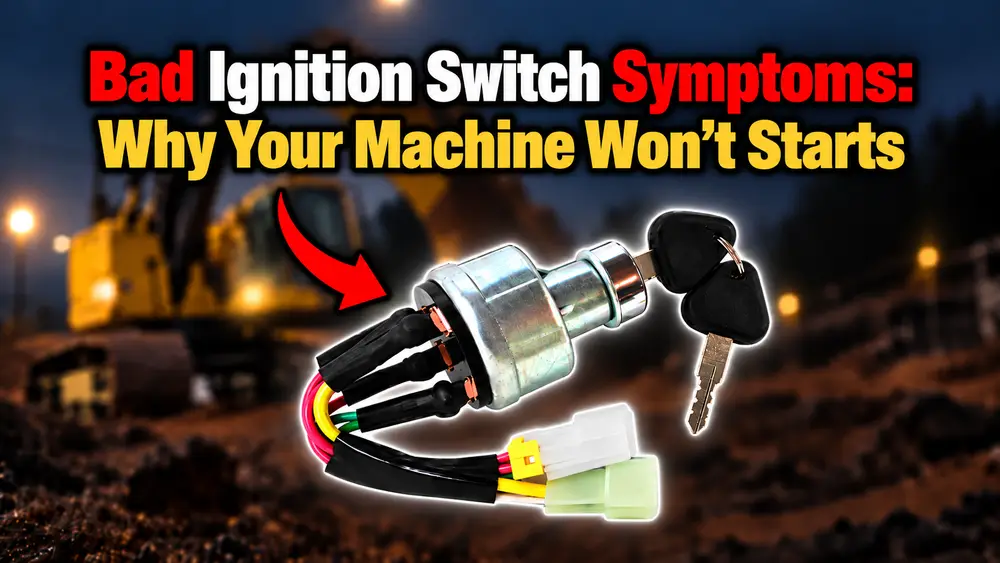
A loader works normally at the end of one shift. The next morning, the key reaches START, but the dashboard goes dark and the starter stays silent. Moving the key slightly brings the gauges back to life. That pattern can point to a worn ignition switch, but it can also come from a loose battery cable, damaged connector, failed relay, or open safety interlock.
Bad ignition switch symptoms on tractors and heavy equipment include intermittent dash power, a no-crank condition, an engine that stops when the key moves, and a starter that remains engaged. These clues matter, but none proves the switch is bad by itself. Follow the voltage through the start circuit before ordering a part.
What Does the Ignition Switch Control?
The ignition switch directs battery power to selected circuits as the key moves through OFF, RUN, PREHEAT, and START. The exact positions depend on the machine. A simple diesel tractor may use the switch to power the gauges, fuel shutoff circuit, glow plugs, starter relay, and starter solenoid.
Modern excavators and loaders can add an engine controller, security module, start authorization relay, or electronic keypad. On these machines, the key switch may send only a low-current request. The controller decides whether the starter relay receives power.
Terminal names also vary. B or BAT often marks battery input, ST or S often marks the start output, and ACC or I may feed accessories or the run circuit. Use the wiring diagram for the exact machine instead of assuming every four-terminal switch shares the same pinout.

Bad Ignition Switch Symptoms to Watch
Look for a pattern across more than one circuit. A starter fault usually affects cranking. A switch or switch-feed fault can interrupt the dash, controller, fuel shutoff, and start-request circuits at the same time.
The Dashboard Stays Dark With the Key in RUN
Turn the key to RUN and watch the gauges, warning lamps, and display. If every switched circuit remains dead while unswitched lights still work, the RUN contact may not be passing power. A blown main fuse, failed battery disconnect, or open feed wire can create the same result.
Check whether battery voltage reaches the switch input before condemning the switch. No voltage at the input means the fault is upstream. Battery voltage at the input but no voltage at the correct RUN output moves the diagnosis toward the switch or its connector.
The Machine Has Power but Will Not Crank
The dash may wake up normally while the starter does nothing in START. Worn START contacts can block the start request even though the RUN contacts still work. The key may need several attempts before the starter responds.
A neutral switch, seat switch, PTO switch, start relay, wiring fault, or starter solenoid can interrupt the same circuit. If the solenoid clicks, use the existing starter solenoid tests before returning to the ignition switch.
The Starter Works Only When You Move the Key
Intermittent cranking while the key is twisted, lifted, or held between positions often points to worn contacts or a loose switch connector. Vibration can make the circuit open and close. This symptom becomes stronger evidence when the voltage at the START output changes with the key movement.
Do not keep forcing the key. A worn lock cylinder can damage the switch drive, and a loose terminal can heat the connector. Inspect the rear of the switch before repeated attempts make the evidence harder to read.
The Engine Starts but Stops When the Key Returns to RUN
The engine may fire while the key is held in START, then stop as soon as the spring returns it to RUN. This pattern can occur when the START contact works but the RUN contact does not keep the controller or fuel shutoff circuit powered. A failed run relay or open run wire can act the same way.
Record which gauges and warning lamps disappear when the engine stops. If several RUN-fed circuits drop together, test the common switch output. If only the fuel shutoff loses power, trace that branch instead.
Dash Power Cuts Out When the Machine Vibrates
A worn switch can open when the cab shakes, especially after years of key weight, dust, and repeated cycles. The display may reset, gauges may fall, or the engine may stop when the key ring moves. A loose connector, weak crimp, damaged harness, or battery disconnect can produce an identical interruption.
Use a visual inspection and a controlled wiggle test while monitoring voltage. Keep the machine parked and the implement lowered. Never create the vibration test by driving equipment with an unstable start-and-run circuit.
The Key Sticks or Does Not Return From START
The key should return cleanly from START to RUN on switches designed with a spring-return start position. If it sticks, the starter can remain engaged after the engine fires. That can over-speed the starter drive and damage the pinion, ring gear, or starter motor.
Shut the machine down if the starter stays engaged. The cause may sit in the mechanical key cylinder, the electrical switch, the start relay, or the solenoid contacts. Do not continue operating until the start command releases correctly.
The Engine Will Not Shut Down With the Key
Some diesel machines stop when the key removes power from a fuel shutoff solenoid or sends a stop request to the controller. If the engine keeps running in OFF, the switch may not be opening the run circuit. A stuck relay, failed stop solenoid, back-fed accessory circuit, or controller problem may also keep the engine alive.
Use the manufacturer-approved shutdown method. Do not reach near belts, fans, or linkages to stop a running engine. Repair the shutdown circuit before returning the machine to service.
The Switch Connector Shows Heat Damage
Brown plastic, melted cavities, a burned odor, or dark terminals show abnormal heat at the connection. Loose terminals and corrosion raise resistance. Current passing through that resistance creates heat, which weakens terminal tension and makes the failure worse.
Replacing only the switch may not solve this condition. Repair the connector, crimp, and damaged wire as the service procedure directs. Then find out whether an added accessory or a relay fault placed too much load on the switch circuit.

Why These Symptoms Do Not Prove the Switch Is Bad
The ignition switch sits near the beginning of the start circuit, so many downstream faults look like switch failure. Test the competing cause that best matches the symptom. This prevents a new switch from becoming another unnecessary part.
| What the machine does | Another likely cause | Check that separates the fault |
|---|---|---|
| No dash and no crank | Battery disconnect, main fuse, ground, or feed cable | Measure voltage at the switch battery-input terminal |
| Dash works but no crank | Safety interlock, start relay, solenoid, or harness | Compare START output with voltage at the relay-control circuit |
| Solenoid clicks but engine does not crank | Weak battery, cable resistance, starter, or locked engine | Perform battery and starter-circuit voltage-drop tests |
| Starts only while key is held | Open RUN circuit, run relay, or fuel-shutoff circuit | Monitor the correct RUN output as the key returns |
| Power cuts out over bumps | Loose terminal, damaged harness, or disconnect switch | Monitor voltage at both sides of each connection |
| Engine will not stop | Stop solenoid, relay, backfeed, or controller fault | Follow the shutdown circuit in the machine diagram |
The Toro Electrical Troubleshooting Guide tells technicians to check battery condition before starting-system tests. It also uses voltage-drop testing to find an open, short, or high-resistance path. That sequence matters because low source voltage can make a good switch appear weak.
Test the Ignition Switch Before Replacing It
Use the machine’s electrical diagram and service procedure. Secure the machine on level ground, lower attachments, set the parking brake, place the transmission and PTO controls in their required safe positions, and keep clear of moving parts. Disconnect the battery only when the procedure calls for an unpowered continuity test.
1. Confirm Battery Power Reaches the Switch
Set the meter to DC volts and connect the negative lead to a verified ground. Probe the switch’s battery-feed terminal using the connector view in the manual. The reading should closely match voltage measured directly across the battery posts under the same condition.
If the feed is missing, inspect the main fuse, fusible link, battery disconnect, positive cable, and harness. Replacing the ignition switch cannot restore a supply that never reaches it.
2. Check the RUN Output
Turn the key to RUN and measure the terminal that should power the run circuit. Compare that reading with the switch input. A large difference under the normal connected load points to resistance in the switch contacts or connector, but use the machine specification when it gives a limit.
Watch the meter while moving the key gently within the RUN detent. A reading that drops out at the switch output while the input stays stable supports an internal-contact fault.
3. Check the START Output
Hold the key in START only as long as the test procedure permits. Confirm that the correct switch terminal sends the start request. If the output is present, move downstream to the safety module, neutral/PTO/seat switches, starter relay, and solenoid.
If the input stays at battery voltage but the START output remains absent, disconnect power and bench-test the switch. Do not bridge terminals with a screwdriver. That can bypass interlocks, damage a controller, or move the machine unexpectedly.
Alt text: Back-probe test at a tractor ignition switch connector. Caption: Comparing switch input and output shows where the start request disappears.
4. Test Switch Continuity With Power Removed
Unplug the switch and use the ohms or continuity setting only after removing power from the circuit. Check the terminal pairs specified for each key position. A good switch closes only the intended paths and opens the others.
The Kubota B2301/B2601 workshop manual provides a useful model-specific example. Its key-switch procedure expects open circuits between specified terminals in OFF and continuity near 0 ohms across specified contacts in START. Those terminal combinations apply to that switch design, not every tractor or excavator.

Separate the Switch From Safety Interlocks
Off-road machines often block cranking unless several conditions are safe. The transmission may need to be in neutral, the PTO disengaged, the parking brake set, and the operator detected in the seat. A failed or misadjusted interlock can leave the START output from the key switch intact while the starter relay receives no command.
Observe the machine display for neutral, PTO, brake, or operator-presence status. Then measure the start request before and after the interlock circuit as the manual directs. Never leave an interlock bypassed after a test.
A controller can also refuse cranking because of an active shutdown, security condition, or low system voltage. Read diagnostic messages before opening the dash. That five-minute check can prevent an hour of testing the wrong circuit.
What Causes an Ignition Switch to Fail?
Mechanical wear builds each time the key turns and springs back. Dust, moisture, fertilizer residue, and wash water can enter a poorly sealed switch. A heavy key ring can also load the lock cylinder on machines that vibrate for hours.
Electrical heat causes another failure path. Loose terminals, weak crimps, or corroded contacts add resistance. Accessories wired directly through a circuit that should control a relay can push more current through the switch than the machine design intended.
Harness tension can pull the connector partly out of the switch. Panel repairs sometimes leave the loom unsupported or route it against a sharp edge. Correct the cause during replacement or the new switch may fail in the same way.
When an Ignition-Switch Fault Makes the Machine Unsafe
Do not operate a machine that stalls when the key or harness moves. Unexpected loss of engine power can remove hydraulic response, steering assistance, braking support, or safe control of an attachment. Park the machine until the run circuit remains stable.
Stop immediately if the starter stays engaged, the connector becomes hot, or insulation smells burned. Disconnect power according to the machine procedure and inspect for heat damage. A no-crank fault is inconvenient; a sticking START circuit or overheated connection can damage other components.
An intermittent switch should not be treated as reliable because the machine started once. Worksite vibration and temperature can reopen the fault. Complete the test while the symptom can still be reproduced.
Match the Replacement to the Original Circuit
Start with the original part number and machine serial number. Then compare the number of key positions, terminal count, connector keying, mounting diameter, bezel depth, spring-return function, voltage system, and sealing. Some switches include a preheat position or use a separate mechanical lock cylinder.
Do not move wires by color alone. Wire colors can change across model years, serial breaks, previous repairs, and replacement harnesses. Label each circuit from the wiring diagram and connector pin location before removing the old switch.
Electronic machines may pair the key, immobilizer, keypad, or controller. Confirm whether programming or key registration is required. A switch that fits the panel can still have the wrong internal contact map.
Fix the Circuit, Not Just the Symptom
A bad ignition switch can leave a machine dark, block cranking, interrupt the run circuit, or hold the starter on. The same symptoms can come from the battery feed, safety interlocks, relays, connectors, and starter circuit. Prove where voltage stops, then confirm the unplugged switch against the correct continuity chart.
If the switch passes but the starter still cannot crank the engine, check the machine number and starter tag before reviewing Amoparts starter motors. When the tag conflicts with the wiring or application record, send a fitment request so the next part follows the diagnosis instead of another guess.


