
How to Clean Diesel Fuel Injectors and When to Replace Them

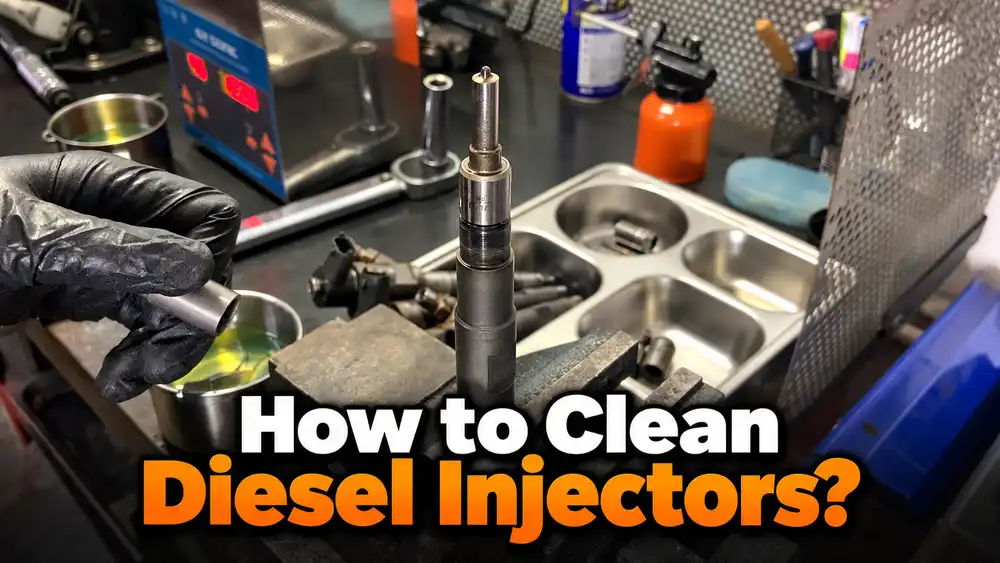
Dirty diesel fuel injectors can cause hard starts, rough idle, smoke, and weak power. Deposits can block fuel flow or spoil the spray pattern. Yet worn parts, low rail pressure, bad wiring, and poor compression can cause the same signs.
Cleaning works when deposits are the problem. It cannot repair wear or an electrical fault. This guide shows how to clean diesel fuel injectors on heavy equipment and when test results call for replacement.
What Diesel Fuel Injectors Do in Your Machine
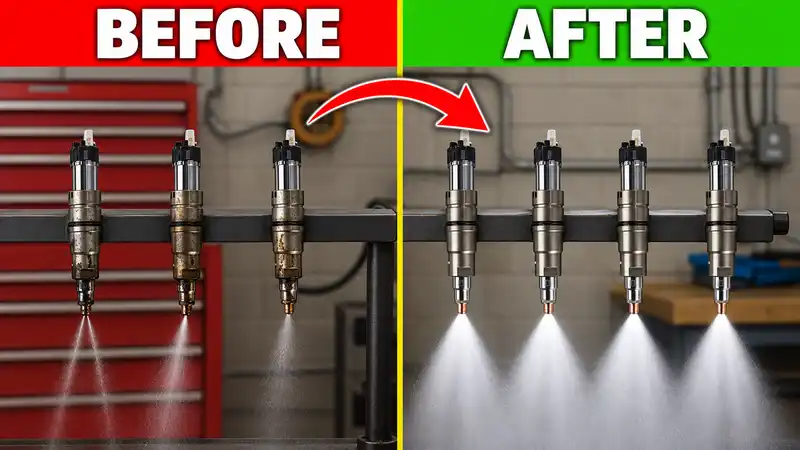
A diesel injector meters fuel, starts the injection event, and shapes the spray inside the cylinder. The fuel must break into fine droplets and mix with air. Good atomization supports clean combustion, steady power, and fast response under load.
Modern common rail systems also make several small injection events during one cycle. Bosch common-rail data lists CP4 system pressure from 1,800 to 2,700 bar. That pressure improves fuel control, but it also makes dirt, water, wear, and unsafe service more serious.
Why Diesel Fuel Injectors Get Dirty
Heat can bake fuel residue onto the nozzle tip. Poor fuel storage can add water, rust, dust, or biological growth. Worn hoses and tanks can also release debris into the fuel stream.
These operating habits can speed up deposit growth:
- Long idle periods keep cylinder temperature low and can increase soot.
- Repeated short runs may stop the engine before it reaches full operating temperature.
- Old or unstable fuel can form gum and varnish.
- Late fuel-filter service allows more dirt and water to reach the injection system.
- A worn high-pressure pump can send bright metal through the rail and injectors.
Do not assume every dirty-looking nozzle only needs cleaning. Metal, rust, deep scoring, or a cracked body points to damage. Find the source before the same debris reaches a cleaned or new injector.
How to Clean Diesel Fuel Injectors Safely
There are two main cleaning paths. An engine-maker-approved fuel treatment may remove light deposits without opening the system. A diesel shop can remove, clean, and test an injector when the fault is more severe.
Choose the method from evidence, not from smoke color alone. Review the injector symptoms and use the test guide before taking parts off the engine.
Prepare the Machine and Remove the Injector
Identify the engine and injector first. Record the engine model, serial number, injector part number, cylinder position, and trim code when present. Confirm whether the system is mechanical, common rail, HEUI, or an electronic unit-injector design.
Clean the engine around each injector before opening a connection. Shut the engine down and follow the stated wait time. Use the approved tool or scan data to confirm that rail pressure has fallen.
Before removal:
- Save fault codes, cylinder-balance data, rail pressure, and return-flow results.
- Drain a fuel sample into a clean, clear jar and check it for water, haze, rust, sludge, or metal.
- Label every injector by cylinder so its code and test result stay with the correct bore.
- Keep approved caps ready for each open injector, rail, pump, and pipe connection.
- Check whether the service manual requires a high-pressure pipe, seal, washer, clamp, or hold-down bolt to be replaced.
Never loosen a high-pressure line while the engine runs. Never use a finger to find a leak. Fuel under pressure can enter the skin and cause a medical emergency.
Disassemble Only the Injector Types That Allow It
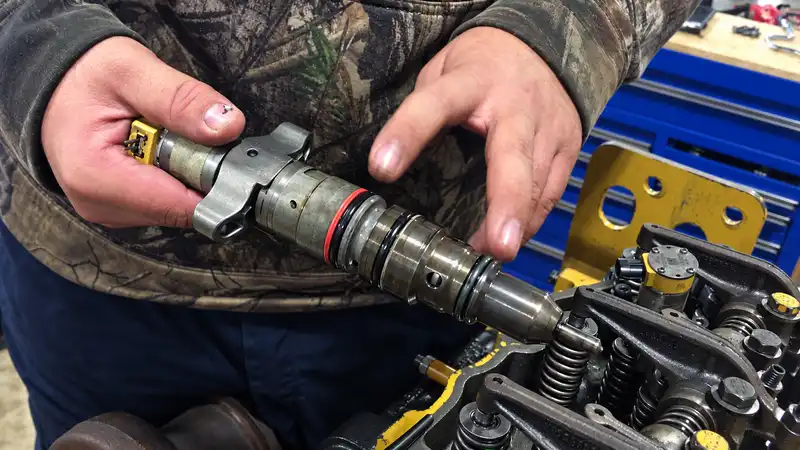
Do not treat all diesel injectors as rebuildable shop parts. Common rail, HEUI, and electronic unit injectors contain small matched parts. They need clean-room tools, approved repair data, and a test bench.
Use this rule:
- Send common rail injectors to a qualified diesel shop unless the maker provides the shop with an approved repair process.
- Send HEUI and electronic unit injectors to a shop equipped for that exact family.
- Open a mechanical nozzle holder only when you have the correct fixture, parts data, torque values, and nozzle tester.
- Keep every needle, nozzle, shim, spring, valve, and body with its original injector.
A socket size from one injector does not fit every design. The same is true for body torque and opening pressure. Use the data for the exact part number.
Clean the Injector Components
For mild deposits, an approved in-tank treatment may be the first step. Use fresh fuel and clean filters. Follow the stated dose, fuel volume, run time, and load. DEUTZ additive guidance gives one maker-specific example for DEUTZ engines. It does not set a rule for every engine.
Do not add gasoline, brake cleaner, carburetor cleaner, or an unknown solvent to the fuel tank. Stop if knock, smoke, fuel dilution, or rail-pressure faults get worse. Repeat the first test under the same engine conditions after treatment.
For removed injectors, a diesel shop should test each unit before cleaning. That first report shows whether the fault is deposit-related or caused by wear. The shop may then use an approved solvent, ultrasonic equipment, and controlled flushing for that injector family.
Protect the Injector Sealing Surfaces
Flat sealing faces can control internal leakage. A scratch, rounded edge, or wrong surface finish can change injector delivery. Do not polish a common rail valve, nozzle, or seal face with general sandpaper.
Some older mechanical nozzle holders allow an approved lapping process. The service data must name the surface, material, finish, and wear limit. If the maker does not allow repair, replace the worn nozzle or injector instead of grinding until it looks bright.
Check the Needle and Nozzle
A clean needle must move as its design requires, but free movement alone does not prove a good injector. Wear can still cause leakage. A blocked hole can still spoil the spray.
The final test depends on the injector type:
- A mechanical injector test may check opening pressure, seat leakage, chatter, and spray form.
- A common rail test should check delivery at several points, return flow, leak tightness, and response time.
- An electronic or HEUI test may also check the coil, actuator, oil side, or control valve.
- A repaired coded injector may need new trim or correction data.
Do not use an open-air spray test. Use a shielded tester made for diesel injection work.
Reassemble, Test, and Install the Injector
The injector should pass its test before it returns to the engine. Bosch injector test systems use stored test plans to measure common rail delivery, return, sealing, and response. Ask the shop for the measured values and pass limits, not only a “cleaned” label.
Use new seals, washers, clamps, pipes, and hold-down hardware where the manual calls for them. Tighten each fastener to the value for that engine and injector. Prime the low-pressure side by the approved method.
After installation:
- Enter the injector code or trim file when the engine requires it.
- Start the engine and keep clear of all high-pressure connections.
- Check for leaks with the approved method, never with a hand.
- Repeat the original fault-code, balance, rail-pressure, return-flow, smoke, and load checks.
- Save the test report and injector code with the machine record.
Signs Diesel Fuel Injectors May Need Cleaning
The machine often shows a change before the operator sees an injector fault code. Compare the signs with filter condition, rail pressure, wiring, and compression. Cleaning is only one possible answer.
- Hard starting: Deposits can reduce the fine spray needed for cold ignition. Low cranking speed, air leaks, or low rail pressure can cause the same result.
- Rough idle: Uneven delivery can make one cylinder contribute less. A weak cylinder or bad connector can feel similar.
- Slow response under load: Restricted delivery may leave an excavator weak while digging or lifting. Check the fuel filter and supply pressure first.
- Black or white smoke: Poor atomization may cause incomplete combustion. Coolant, low compression, timing, and airflow faults can also change smoke color.
- Higher fuel use: A leaking or poor-spray injector can waste fuel, but machine load and idle time must be compared too.
- Injector knock: Wrong delivery or timing may create a sharp knock. Stop and test before more fuel washes the cylinder wall.
How Often Should Diesel Fuel Injectors Be Cleaned?
No single 1,000-, 1,500-, or 2,000-hour cleaning rule fits every diesel engine. Many makers schedule fuel-filter and water-separator service but do not call for routine injector opening. Follow the manual for the exact engine.
Check the system sooner when:
- The machine uses fuel stored for long periods.
- Mobile tanks or transfer pumps show dirt or water.
- Filters plug before their normal service point.
- The engine spends long hours at idle or light load.
- Fuel analysis finds water, particles, or unstable fuel.
- A new injector fails much earlier than expected.
Use symptoms and test data to decide on cleaning. A clean-looking injector does not need scheduled disassembly when the engine runs well and its measurements pass.
Clean or Replace: What the Injector Tests Mean
Clean the injector when deposits are likely and the hard parts still pass inspection. An approved treatment may suit mild early symptoms. Bench cleaning makes more sense when an injector can be removed, tested, and proven after service.
Cleaning is a reasonable choice when:
- Fuel and filter checks show no metal or severe water damage.
- The injector body, connector, inlet, threads, and nozzle have no physical damage.
- The coil or actuator passes its electrical test.
- Pre-clean bench data points to a deposit or sticking problem.
- Post-clean values return to the maker’s limits.
Replace or use a qualified remanufactured unit when:
- The body is cracked, corroded, scored, or heat-damaged.
- The coil, actuator, control valve, or nozzle has failed.
- Return flow, delivery, leakage, or response stays outside the limit after cleaning.
- The shop cannot complete an approved repair or issue the needed calibration code.
- Metal from a failed pump has damaged the injector set.
Metal changes the whole repair. Inspect the tank, filters, pump, rail, pipes, controls, and every injector. One clean injector cannot survive in a system that still carries hard debris.
How to Prevent Diesel Fuel Injector Problems
Clean fuel protects injectors better than repeated deep cleaning. Cummins fuel limits cite ISO 18/16/13 and no more than 200 parts per million of water. Cummins also identifies 4- and 6-micron particles as critical sizes for modern injection systems.
Use these habits:
- Buy fuel from a source with good storage and high turnover.
- Keep bulk tanks, caps, vents, transfer hoses, and nozzles clean.
- Drain the water separator at the stated point and after a water alert.
- Replace primary and secondary filters on schedule and use the required efficiency.
- Keep new filters sealed until installation and prefill them only when the manual allows it.
- Clean around every fitting before opening the fuel system.
- Check the filter warning signs before blaming an injector.
A Donaldson fleet case found water and dirt in bulk tanks and mobile fuel trucks. After the fleet improved fuel handling and filtration, emergency repairs fell by 50 percent and injector failures became rare. Fixing the fuel source protected more parts than repeated injector work.
Final Thoughts
Clean diesel injectors support steady power, efficient fuel use, and longer engine life. Approved fuel treatments can handle light deposits, while professional cleaning and bench testing can address more serious buildup. Clean fuel, timely filter service, and careful fuel-system work also reduce repeat trouble and unexpected downtime.
If the injectors are too worn to recover, Amoparts supplies dependable diesel injectors to help get your machine back to work without delay. Shop now, or send a parts inquiry when you need help confirming the correct replacement.


